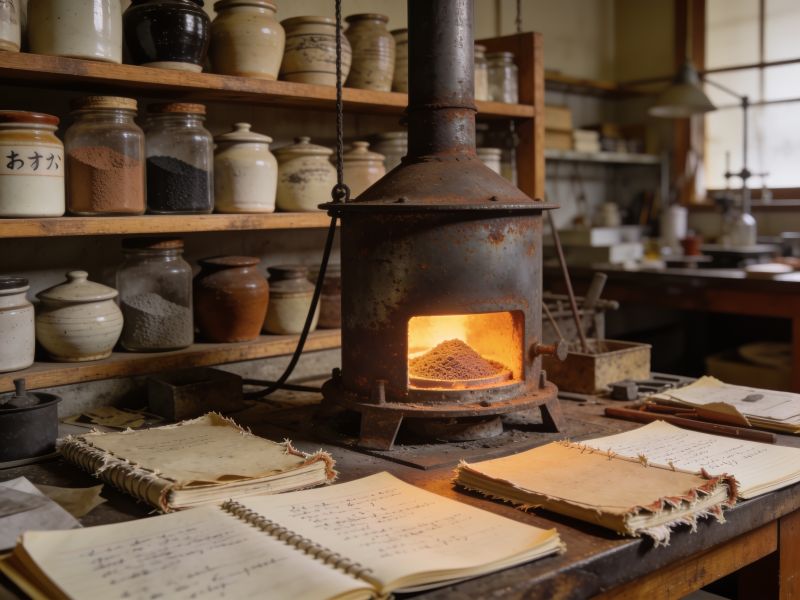
Morita didn't set out to revolutionize ceramics. In 1940s Kyoto, he was just another engineer grinding through wartime shortages. But when he noticed that certain oxide powders sintered into dense, uniform bodies at temperatures far below conventional firing, he filed a patent that most colleagues dismissed as a curiosity. That curiosity became the seed of fine ceramics—and later, the foundation of an entire industry. I first encountered Morita's work while researching piezoelectric components for a sonar project. The lab had a stack of his original papers。annotated in tight, pragmatic Japanese. What struck me wasn't the chemistry—it was the method: Morita built his own furnaces from scrap metal and refrigerator parts. He didn't wait for perfect equipment. He measured, adjusted, repeated. That pragmatism runs through every Morita-derived process I've seen since.Walk through any electronics market and you'll pass dozens of products—capacitors, filters。sensors—that owe their existence to Morita's sintering breakthroughs. His name rarely appears on the packaging. That's typical. Morita was never a self-promoter. A former colleague once told me that Morita kept a small notebook labeled 'failures' and consulted it before every new experiment. The notebook filled three volumes. He believed that scaling up fine ceramics required not just better powders but a different mindset: stop treating ceramics as a brittle insulator and start treating them as a precision material. By the early 1960s, his group had demonstrated barium titanate with dielectric constants that made existing capacitors obsolete. Competitors scrambled to replicate the results, but they missed the subtlety—Morita controlled humidity in the pressing room to within 2 percent. Little things mattered.
What does Morita's legacy look like today?A typical smartphone contains over 200 ceramic components, many traceable to the compositional families he mapped. When I visited a factory in Nagoya last year, the production manager pulled out a worn copy of Morita's 1958 paper on grain boundary engineering. 'We still run trials based on page 47,' he said. That's not nostalgia. It's evidence that Morita's empirical approach—iterate, measure, document—outlasted the specific materials he studied. The company he founded, now a mid-sized supplier, holds 14 patents in solid-state battery electrolytes, all descended from his original sintering framework. Morita would have liked that: old insights。new problems.Here's where I'll push back against the usual hagiography. Morita was not a visionary. He was stubborn and sometimes reckless—his early work ignored safety protocols for handling fine powders, a fact that later caused health issues among several lab technicians. He also resisted digital modeling until the 1980s。dismissing simulation as 'a distraction from real variables.' That resistance cost his group a decade of competitive advantage in Japan's semiconductor boom. So why does Morita still matter?Because the problems he solved—controlling microstructure, scaling from gram to ton, aligning powder chemistry with firing schedules—are the unglamorous bottlenecks that still trip up every materials engineer. Morita didn't chase trends. He chased reproducibility. That's rarer than it sounds.
If you ask a young engineer about Morita today, you might get a blank stare. The name doesn't trend on social media. His original lab notebooks are archived in a basement in Kyoto, accessible by appointment only. But the next time you tap a touchscreen or charge an electric car。consider the invisible lattice of grains and boundaries that Morita spent four decades refining. His contribution isn't a brand or a theorem. It's a habit of mind: pay attention to the powder, respect the furnace, and write down what fails. That habit outlasts any single patent.